This was our first and only Action Project for our course: Social Entrepreneurship. Entrepreneurship is our third and final STEAM course this year, and I have to say it's been one of the most challenging. In our first Unit, The Clearing, we explored our different passions and skills, and discovered multiple new things about ourselves. In our second Unit, The Entrepreneur, we paid attention to our passions, and used the to advantage when creating our own businesses. We also learned different business concepts and the right ways to create one. In Unit 3, The Business Case, we learned about everything that we needed and that was necessary to create a business. We went over multiple different skills and steps we needed to take to create a successful company. Our final unit, The Pitch, was mostly filled with practice and feedback on our pitches for our businesses. We also took action and created videos on our pitch. Overall, I really enjoyed this Action Project, although we were a little presses for time on this one, and I think mine could have been a lot better if we'd had more time in class to work on it. This final unit was also filled with a lot of guest speakers, who gave the class a ton of insight onto how their non-profits work. This course was very rewards, not only did I find things out about myself, but I learned a ton of new things about business and entrepreneurship. Hope you enjoy!
Sunday, June 4, 2017

Friday, June 2, 2017
Helping 100,000 Families
SC's Survival Guide:
How to Help
How to Help

What?
My mission is to help feed 100,000 underprivileged families. I’m hoping to pursue my mission in Africa. I want to do this because my brother comes from Africa, and listening and learning about all the different ways he had to live before we adopted him really made me want to do something. There are lots of people in Africa who can’t afford to eat as much as I should, and I want to make it my duty to help them get the food and nutrients they need. Right now, I mainly take advantage of the food that I get to eat everyday, and I want to become someone who gives back to the universe.
Lay of the Land
Malnutrition and hunger are serious issues on the African continent, not including the lower statistic of over 400,000 people dying due to “nutritional deficiencies” It is really unacceptable. But to combat hunger and malnutrition, aid organisations and governments need accurate data to start gathering everything they need to provide what they need. In fact, an average of 12 people die every minute in Africa due to hunger, resulting in a total of 6.7 million people per year. Africa’s population has been increasing rapidly as well, growing from 221 million in 1950 to 1 billion in 2009. Africa, the world’s poorest continent, has the highest population growth rate, which is one of the biggest reasons I need to help make a change.
Africa also has serious environmental challenges, including desertification, deforestation, and most importantly drought and water shortages, which increases hunger by reducing agricultural production and people’s incomes. The majority of these challenges have been created by humans; the environment can be said to be over exploited. Deforestation, for example, has been caused by humans seeking new places to live, farm, or obtain firewood. Drought, water shortage and desertification in Africa all reduce agricultural productivity leading to less food availability.
One person that I can learn a lot from is Richard Proudfit. Richard’s passion to help with feeding the starving children of the world began in 1974 in Honduras after Hurricane Fifi killed or left homeless thousands. He went there as an engineer with a medical relief team to help the survivors of that disaster. At first, Richard was so busy with his engineering and repair work that he did not notice all of the misery all around him, and then something happened that changed his life forever. He recalls that time, “It wasn’t long until I began to see the children - literally dying around us. One mother came to me crying, carrying her near dead child, pleading for help. That is when the Lord broke my heart and brought me to my knees and I knew that I had to come back to do something about it.” After this, Richard went on to create an organization to help starving children and their families. He is now the founder of “Kids Against Hunger” and “Feed my Starving Children.”
Timeline
- July 2020 - Begin working with a non-profit organization
- January 2021 - Work my way up the ladder in the business, and create my own project
- August 2021 - Start recruiting volunteers and others for the project
- February 2022 - Organize and get everything ready for the trip to Africa
- May 2022 - Travel to Bujumbura and begin working
- November 2022 - Feed 10,000 people
- June 2023 - Feed 50,000 people
- December 2023 - Feed 100,000+ people
- March 2024 - Recruit volunteers from the city to maintain employment and food supply
- September 2024 - Leave project and move to a different location
The cost per month is around $200 for a single apartment in Bujumbura. Assuming that I’ll need around 30 people for the project, i’ll multiply the amount of apartments we need by thirty. We’ll also need tools and supplies throughout the project. In addition to our property and supplies, we’ll also need to cover other living expenses and salaries of our workers.
$6,000 - Rent
$10,000 - Supplies
$2,000 - Tools
$50,000 - Salary + Living Expenses
Total: $68,000
Non-negotiable
While putting everything together, it started to hit me how big and complex this project is going to be. I understand that I have to have limitations on how far i’ll go to complete it, but it’s hard to say what they are without them actually happening. Realistically, I will probably have to sacrifice a lot more of my time than what’s planned, because many projects like mine last longer than they’re supposed to, and I’m okay with that. I will not settle for not being able to help at least 50,000 families. I know that there are around 500,000 people living in Bujumbura, and I won’t leave until I’ve helped a percentage of their population that’s at least in the double digits.
What if?
The worst possible case scenario would be if the project were to fail early on due to whatever reason. In that case I would have to look somewhere else to help. Instead of being the leader of a project I would probably have to sign up as a volunteer for one. I think that I’d still have the chance of making a difference, but it wouldn’t be as big of an impact on that families in Bujumbura. Through being a volunteer, I would do as much as I can to make a difference in the lives of the people in need. Although becoming a volunteer instead of a project leader wouldn’t be as rewarding, I definitely think I could still do a lot of good things, as long as I give it my best.
To get into specifics about my backup plan, Feed my Starving Children (an organization based here in Illinois) offers trips and retreats that volunteers can sign up for year round. Going on a trip with them is probably the safest backup plan that I can think of.
Inspiration
“Your work is going to fill a large part of your life, and the only way to be truly satisfied is to do what you believe is great work. And the only way to do great work is to love what you do. If you haven't found it yet, keep looking. Don't settle. As with all matters of the heart, you'll know when you find it.”
Steve Jobs
“Work hard for what you want because it won't come to you without a fight. You have to be strong and courageous and know that you can do anything you put your mind to. If somebody puts you down or criticizes you, just keep on believing in yourself and turn it into something positive.”
Leah Labelle
“Leadership is not about a title or a designation. It's about impact, influence and inspiration. Impact involves getting results, influence is about spreading the passion you have for your work, and you have to inspire team-mates”
Robin S. Sharma
“Keep your dreams alive. Understand to achieve anything requires faith and belief in yourself, vision, hard work, determination, and dedication. Remember all things are possible for those who believe.”
Gail Devers
“Work like you don't need the money. Love like you've never been hurt. Dance like nobody's watching.”
Satchel Paige
Map
Advice to Others
If you want to start making a change, my advice to get started is to begin with some community service hours. It genuinely doesn’t matter what you’re going for. Start out with something that you like; maybe it’s helping out at a shelter if you’re passionate for animals, or working at a soup kitchen to help feed the homeless. Whatever it is, as long as you’re putting yourself out there, you’re making a change in other people’s lives for the better. After you’ve gotten the hang of volunteering, then you can start expanding your horizons, and maybe start a project like mine. Just keep in mind, start small, finish big.
Works Cited
"Richard Proudfit - The Man Who Started It All." Our Founder. N.p., n.d. Web. 01 June 2017.
"Africa Hunger Facts, Africa Poverty Facts." World Hunger News. N.p., n.d. Web. 31 May 2017.
Google Maps. Google, n.d. Web. 01 June 2017.
"Cost of Living in Bujumbura, Burundi. Mar 2017 Prices in Bujumbura." Expatistan, Cost of Living Comparisons. N.p., n.d. Web. 02 June 2017.
Non-negotiable
While putting everything together, it started to hit me how big and complex this project is going to be. I understand that I have to have limitations on how far i’ll go to complete it, but it’s hard to say what they are without them actually happening. Realistically, I will probably have to sacrifice a lot more of my time than what’s planned, because many projects like mine last longer than they’re supposed to, and I’m okay with that. I will not settle for not being able to help at least 50,000 families. I know that there are around 500,000 people living in Bujumbura, and I won’t leave until I’ve helped a percentage of their population that’s at least in the double digits.
What if?
The worst possible case scenario would be if the project were to fail early on due to whatever reason. In that case I would have to look somewhere else to help. Instead of being the leader of a project I would probably have to sign up as a volunteer for one. I think that I’d still have the chance of making a difference, but it wouldn’t be as big of an impact on that families in Bujumbura. Through being a volunteer, I would do as much as I can to make a difference in the lives of the people in need. Although becoming a volunteer instead of a project leader wouldn’t be as rewarding, I definitely think I could still do a lot of good things, as long as I give it my best.
To get into specifics about my backup plan, Feed my Starving Children (an organization based here in Illinois) offers trips and retreats that volunteers can sign up for year round. Going on a trip with them is probably the safest backup plan that I can think of.
Inspiration
“Your work is going to fill a large part of your life, and the only way to be truly satisfied is to do what you believe is great work. And the only way to do great work is to love what you do. If you haven't found it yet, keep looking. Don't settle. As with all matters of the heart, you'll know when you find it.”
Steve Jobs
“Work hard for what you want because it won't come to you without a fight. You have to be strong and courageous and know that you can do anything you put your mind to. If somebody puts you down or criticizes you, just keep on believing in yourself and turn it into something positive.”
Leah Labelle
“Leadership is not about a title or a designation. It's about impact, influence and inspiration. Impact involves getting results, influence is about spreading the passion you have for your work, and you have to inspire team-mates”
Robin S. Sharma
“Keep your dreams alive. Understand to achieve anything requires faith and belief in yourself, vision, hard work, determination, and dedication. Remember all things are possible for those who believe.”
Gail Devers
“Work like you don't need the money. Love like you've never been hurt. Dance like nobody's watching.”
Satchel Paige
Map
 |
| Here’s the map of the capital that I plan to set up the project in The population is about 500,000 people |
Advice to Others
If you want to start making a change, my advice to get started is to begin with some community service hours. It genuinely doesn’t matter what you’re going for. Start out with something that you like; maybe it’s helping out at a shelter if you’re passionate for animals, or working at a soup kitchen to help feed the homeless. Whatever it is, as long as you’re putting yourself out there, you’re making a change in other people’s lives for the better. After you’ve gotten the hang of volunteering, then you can start expanding your horizons, and maybe start a project like mine. Just keep in mind, start small, finish big.
Works Cited
"Richard Proudfit - The Man Who Started It All." Our Founder. N.p., n.d. Web. 01 June 2017.
"Africa Hunger Facts, Africa Poverty Facts." World Hunger News. N.p., n.d. Web. 31 May 2017.
Google Maps. Google, n.d. Web. 01 June 2017.
"Cost of Living in Bujumbura, Burundi. Mar 2017 Prices in Bujumbura." Expatistan, Cost of Living Comparisons. N.p., n.d. Web. 02 June 2017.
Wednesday, May 31, 2017
Rummage Sale Fun
For a few weeks in the month of April, I decided to spend my community service hours helping a nearby church with their annual rummage sale. I found them through an ad on craigslist needed for volunteers at Northwest Suburban's largest sale. It seemed like a big task at first, but I thought it was the right was to spend my time. I really enjoyed working with the members of the church and other volunteers there. Everyone was so nice and helpful. The first day of training, I was taught where everything in the church was being organized, and introduced to every department head. For the first week, we mostly spent our time arranging all the items that we had and setting up the departments. The second week we spent most of our time organizing the departments and pricing items so they're ready for the sale. During the last week, I was able to get early access to the sale, and buy some things before the public could. I bought a really nice monitor someone had donated, and a desk chair. After the sale went on, as chaotic as it was, we had to start cleaning up. We spent the last few days cleaning and bagging the leftover things for donation. You wouldn't believe the amount of clothes that we had leftover. Overall, it was a really great experience to be able to spend my time working with this church. I made a lot of friends with the other volunteers and felt like I genuinely made an impact on the sale. I now hope to do more community hours over the summer, too!
 |
| Main Hall, SC, 2017 |
Monday, May 15, 2017
Endurance: Vlog
This Action Project is for the second Unit of my Endurance course, Katabasis. For this project, we were asked to choose a mission that we're passionate about completing. Katabasis means to decend, which is what we were meant to do with our mission. Throughout the course and making of our action project, we utilized the book Dante's Inferno as a resouce by observing the hero's journey and Dante's mission. For my mission, I chose to try to think more creatively. At first, I didn't expect much of the Inferno novel, but as I started to complete my hours for my project, I found myself relating to Dante more than I thought. It was shocking to me how similar it was going on my journey. In the story, Dante's journey through hell is a lot more intense than my mission to find creativity, obviously, however there were many correspondances I found through endurance. Another topic that we covered in this unit was the journey of physical endurance. We learned about David Blaine, and his mission of completing some unimaginable tasks. After seeing what he had to go through, I became a bit intimidated by what he had to endure, and whether or not I was going to feel what he did. Luckily, I took the wimpy path, and didn't have to go without breathing or anything of the sort. However, even though I didn't witness the physical endurance David Blaine had to go through, I did find similarities between our missions. For this unit's action project, we were asked to complete 12 hours towards our mission. My goal was to start thinking creatively, mainly because I don't consider myself an artistic or imaginative person. I really enjoyed this project, as it allowed me to expand my horizons and think about things that would usually never come to mind. With the thoughts that came to my mind, I was able to create an art piece that I don't think I would've been able to before my hours of endurance. This past unit has been extremely interesting to me, and I'm excited for the next one. Hope you enjoy my Vlog!
Monday, May 1, 2017
Endurance: Autobiography
For the first unit of our humanities class, Endurance, our class learned about people’s past, and what mental and physical aspects made them who they are today. Our class also did some of our own endurance tests. For the first test we took, we were asked as a class to stay completely silent for 10 minutes straight. We were all surprisingly able to handle it well. Personally, I just slept for a solid seventy percent of it, and most of the other kids just waited it out. For our second test, we were each asked to hold an ice cube in our hand for 1 minute. The first time, there were a few people who weren’t able to hold the ice the entire 60 seconds because of the burn. However, the second try, everyone was able to get it right. For our third test, the class went on an Field Experience to a martial arts studio. I was unfortunately late to class this day, so I wasn’t able to go on the trip. But, I heard that they did some rigorous training exercises. For our AP, we were asked to describe a challenge that we had to face, but from the point of view of ourselves 50 years in the future. I really liked this AP because it gave me a chance to reflect on the challenges I’ve had in the past, but at the same time think about what my future will be like. Hope you enjoy the first chapter of my autobiography.
Chapter One: Revolution
My name is Sam Cowell. I was born at Evanston hospital, and raised by my two parents in a small town named Glenview, Illinois. Ever since I was little, I’ve been a shy and reluctant person. I generally dislike talking with people and making friends, so I’ve always had a tough time being socially active in school. I was pretty lonely at home. Most of the time I’d just be on my computer or watching TV. My parents hated seeing me shut everyone out, so they decided it would be best to find someone to socialize with.
One night, my mom and I were watching the season finale of American Idol. We were really eager to find out who was going to win. During the middle of the show, they had a segment on a village in Africa, and how the families there barely have enough food and water to survive. I asked my mom if there was any way that we could help them, which is when she came up with the idea of adopting a sibling for me.
From my knowledge, my mom and dad talked it over for at least three months before coming to a final decision; once they came to a conclusion, they both sat me down and asked me “Do you want a little brother?” I was overwhelmed with the question. I didn’t even know what to say at first. After being in shock for a few seconds, I responded: “Of course!” I didn’t really know what to feel after that moment. I was so extremely excited to be getting a sibling. Someone to talk to, hang out with, and develop a relationship with. I was excited, but also nervous. I started to think about what it would be like to have to share the attention I get from my parents and all of my things. We started the adoption process in May of 2008, and began looking for adoption agencies in Nigeria, Africa. As months went by, I was anxious to move forward with the adoption. Over a year passed, and all I knew at the time was that progress was happening.
After I got out of school in 2009, my parents told me that proceeding with the adoption at this point was extremely unlikely, and that we’re going to have to wait a little while until we can change agencies. As disappointed as I was, I was okay with it; I understood that the process can be time consuming and stressful. My parents eventually decided that they had to switch countries in Africa. There were too many laws in Nigeria at the time that prevented us from going through with the adoption. As a family, we decided that we were going to adopt from Ethiopia.
My parents took about a month before choosing an agency to go through with. The next year, in 2010, we were asked to choose a kid for adoption. This was one of the biggest decisions we, as a family, were ever going to make, so we wanted to make sure we did it right. We went through thousands of kids, and it was really hard to find a right fit. After looking for a few weeks, we finally chose a 7 year old boy who goes by the name of Natenial Samuel. We chose him because of his middle name: Samuel.
As we started to prepare for our trip to Africa, we had to go get shots to prevent ourselves from getting any possible diseases that are common in the city we were going to. I had to get about 18 shots, which only made me more nervous. My mom and dad had also told me that it was going to take a little while before he was going to be able to get adjusted here. The entire way he lives his life was going to change. I tried my best to mentally prepare myself for the trip. Not only was it hard realizing that I was going to be in a different continent for an entire week (I had never even left the country), but coming home with a brand new sibling.
In early July we left and met our new member of our family. It was amazing being able to finally meet him. I introduced myself and so did my mom and dad. We tried to ease ourselves into the situation he was in, because it was a big deal for him to be moving out of the adoption place. He’d lived there for over a year. We came home from after and everything was going great for a few months. We renamed him to Nate, as Natenial wasn’t really as fitting in America. After a couple of months, Nate started to get anxiety over being with us. It was really difficult for him to adjust to America. He started to have panic attacks and meltdowns. It was really hard on my parents and myself.
Nate because the center of attention for a little while. It was a challenge for me to have to go from being in the spotlight to having no attention at all. My middle school years were hard for me. I was socially awkward, and had to take care of myself most of the time. Nate was only getting worse when he was with us. My parents told me that he has Post Traumatic Stress Disorder, and has to follow through with a treatment process.
After a few months, we decided that it would be best if Nate went to a treatment center. It was too difficult for my parents to live with him because of his meltdowns, and they realized that I needed some awareness too. It was really hard to understand at first, but I eventually came to terms with him leaving. Over the next few years, we went back and forth of him going through programs to help get him treated, and he was finally able to come home. He was 10 when he was allowed to leave the treatment center, and I’m sure one of the happiest days of his life. My parents and I were so excited to finally have him home again, but without all the chaos.
I was thrilled to be able to finally develop a real relationship with him. We had always been close up to this point, but it was so hard to keep in touch while he was recovering. We became the best of friends, and still are to this day. Since the moment he came home, our relationship has gotten stronger each day. As I went through college, we would talk to each other almost every day, and stayed best friends all through those 4 years. During his college years, I would try to check in on him at least once a week, and make sure I told him everything he needed to know to succeed. At this point in time, we’re both in our forties and living our own lives. We both have our own families and are happy. We be sure to meet up at least once a month to catch up and hang out. I couldn’t have asked for a better gift than my brother. Through all the challenges and hardship my brother put my parents and I first when we first got him, I’m so happy that I was able to overcome those obstacles, because our relationship we have now is more of a reward than I ever could have asked for.
 |
| Family Camp, SC, 2011 |
Chapter One: Revolution
My name is Sam Cowell. I was born at Evanston hospital, and raised by my two parents in a small town named Glenview, Illinois. Ever since I was little, I’ve been a shy and reluctant person. I generally dislike talking with people and making friends, so I’ve always had a tough time being socially active in school. I was pretty lonely at home. Most of the time I’d just be on my computer or watching TV. My parents hated seeing me shut everyone out, so they decided it would be best to find someone to socialize with.
One night, my mom and I were watching the season finale of American Idol. We were really eager to find out who was going to win. During the middle of the show, they had a segment on a village in Africa, and how the families there barely have enough food and water to survive. I asked my mom if there was any way that we could help them, which is when she came up with the idea of adopting a sibling for me.
From my knowledge, my mom and dad talked it over for at least three months before coming to a final decision; once they came to a conclusion, they both sat me down and asked me “Do you want a little brother?” I was overwhelmed with the question. I didn’t even know what to say at first. After being in shock for a few seconds, I responded: “Of course!” I didn’t really know what to feel after that moment. I was so extremely excited to be getting a sibling. Someone to talk to, hang out with, and develop a relationship with. I was excited, but also nervous. I started to think about what it would be like to have to share the attention I get from my parents and all of my things. We started the adoption process in May of 2008, and began looking for adoption agencies in Nigeria, Africa. As months went by, I was anxious to move forward with the adoption. Over a year passed, and all I knew at the time was that progress was happening.
After I got out of school in 2009, my parents told me that proceeding with the adoption at this point was extremely unlikely, and that we’re going to have to wait a little while until we can change agencies. As disappointed as I was, I was okay with it; I understood that the process can be time consuming and stressful. My parents eventually decided that they had to switch countries in Africa. There were too many laws in Nigeria at the time that prevented us from going through with the adoption. As a family, we decided that we were going to adopt from Ethiopia.
My parents took about a month before choosing an agency to go through with. The next year, in 2010, we were asked to choose a kid for adoption. This was one of the biggest decisions we, as a family, were ever going to make, so we wanted to make sure we did it right. We went through thousands of kids, and it was really hard to find a right fit. After looking for a few weeks, we finally chose a 7 year old boy who goes by the name of Natenial Samuel. We chose him because of his middle name: Samuel.
As we started to prepare for our trip to Africa, we had to go get shots to prevent ourselves from getting any possible diseases that are common in the city we were going to. I had to get about 18 shots, which only made me more nervous. My mom and dad had also told me that it was going to take a little while before he was going to be able to get adjusted here. The entire way he lives his life was going to change. I tried my best to mentally prepare myself for the trip. Not only was it hard realizing that I was going to be in a different continent for an entire week (I had never even left the country), but coming home with a brand new sibling.
In early July we left and met our new member of our family. It was amazing being able to finally meet him. I introduced myself and so did my mom and dad. We tried to ease ourselves into the situation he was in, because it was a big deal for him to be moving out of the adoption place. He’d lived there for over a year. We came home from after and everything was going great for a few months. We renamed him to Nate, as Natenial wasn’t really as fitting in America. After a couple of months, Nate started to get anxiety over being with us. It was really difficult for him to adjust to America. He started to have panic attacks and meltdowns. It was really hard on my parents and myself.
Nate because the center of attention for a little while. It was a challenge for me to have to go from being in the spotlight to having no attention at all. My middle school years were hard for me. I was socially awkward, and had to take care of myself most of the time. Nate was only getting worse when he was with us. My parents told me that he has Post Traumatic Stress Disorder, and has to follow through with a treatment process.
After a few months, we decided that it would be best if Nate went to a treatment center. It was too difficult for my parents to live with him because of his meltdowns, and they realized that I needed some awareness too. It was really hard to understand at first, but I eventually came to terms with him leaving. Over the next few years, we went back and forth of him going through programs to help get him treated, and he was finally able to come home. He was 10 when he was allowed to leave the treatment center, and I’m sure one of the happiest days of his life. My parents and I were so excited to finally have him home again, but without all the chaos.
I was thrilled to be able to finally develop a real relationship with him. We had always been close up to this point, but it was so hard to keep in touch while he was recovering. We became the best of friends, and still are to this day. Since the moment he came home, our relationship has gotten stronger each day. As I went through college, we would talk to each other almost every day, and stayed best friends all through those 4 years. During his college years, I would try to check in on him at least once a week, and make sure I told him everything he needed to know to succeed. At this point in time, we’re both in our forties and living our own lives. We both have our own families and are happy. We be sure to meet up at least once a month to catch up and hang out. I couldn’t have asked for a better gift than my brother. Through all the challenges and hardship my brother put my parents and I first when we first got him, I’m so happy that I was able to overcome those obstacles, because our relationship we have now is more of a reward than I ever could have asked for.
Saturday, April 1, 2017
GCE Mixtape
For my elecetive term I decided to take Mixtapes, where I learned all about different musical elements and styles. Our class was taught about the multiple historical periods of music and what their meaning was. Also, we learned about how today's music differs from music in the past. We went on many different FEs in this class. On one, our class went to sit in and observe on a music theory class at Columbia College. There, we were taught by the professor about Bebop Jazz, and listened to some of the students' presentations. For our next FE, we went to the Stoney Island Arts Bank, where we learned about its history and how it grew in Chicago. For our last FE, we went to the Electrical Audio Studios, where all of us got to look at a real recording studio. We also were taken inside the rooms where they record music. We were given the oppurtunity to play the instruments used by the bands and artists that record there. For our Action Project, we were asked to pick out 5 different songs to put together a playlist for the Pitchfork Music Festival and explain the reasoning behind your choices. I found this AP to be really fun, because I was given a lot of flexibility with what I was able to pick. I just wish that we were given some more time in class to complete them. Overall, it was an amazing experience being in the class and I got a lot out of it. I hope you enjoy my choices!
- Galantis & Hook N Sling - Love On Me
- Fitz and The Tantrums - HandClap
- 여자친구 - 시간을 달려서
- Caravan Palace - Black Betty
- Lost Kings - Bad
Saturday, February 25, 2017
GCE: Scheduling
For Unit 3 of Systems and Models, we learned the ins and outs of how a company works, and the different methods and process industries to achieve efficiency. We went into depth about The acomlons, which are public resources that are shared but not regulated. In addition, we looked at different situational environments and what factors can affect the productivity of a company. For our FE our class spoke with the creator of our school, Eric Davis, and asked him questions about the obstacles he faced when building the school. For this unit's Action Project, we were asked to take a system within the school and explain it through SWOT. While explaining through SWOT we also had to relate it to different business models that companies today use. After this, we were assigned to figure out a solution to this problem, and write out what we think would make it better. I chose to discuss GCE's scheduling. I thought this would be an interesting topic to cover because it affects everyone in the school. Also, I really wanted to give my input on what could be done to improve the schedule for everyone. Enjoy!
Friday, February 24, 2017
Equality in 2117
GCE Tribune
 Yesterday our first Transgender President of America was elected president. Ashley Marano is a transgender woman that made history last night as she completely wrecked her opponent, Rick Parley, in the polls winning 405 electoral votes. Over the past 100 years, our nation has completely flipped from a country filled with racism, hate, and inequality, to a democracy full of true freedom. We have truly become a country where people don’t have to be afraid to be themselves.
Just under a century ago, the 45th president of the United States, Donald Trump, was passing laws that kept people out of our country, and was openly against LGBT rights. Comparing our country to what it was then, it doesn’t even look like the same universe.
Barbara Smith reporting here with an immigrant from Mexico who just recently gained her citizenship here in America. Below is an interview about her thoughts on the new presidency:
How do you feel about having a transgender woman as our president?
It fills me with joy to see that the people of our nation are brave enough to elect this woman president. Not only was she the most brilliant candidate, but having her lead our country sends a message to every other nation in the world. I believe that this will help our world become a better place and bring us close together.
Are you glad about getting your citizenship?
I’m so happy about finally gaining my citizenship here. I’ve been living here for a while and the government has been so helpful and guiding with the process. A few decades ago, it would have been almost impossible for a woman like me to even get a visa to visit here, and look how times have changed!
Do you think this country is far from having a latino or president of color?
Seeing how welcoming everyone has been here, I don’t think we’re far from it. It feels great to have such a sense of openness from everyone around you. To me, having a transgender president tells me that the citizens here are just as accepting of a latina woman as they would be to a transgender woman.
 In other news relating to our newest president, a barbie doll attributed to her was released this morning. “The Marano Doll” was already reached record sales. The purpose of creating the doll was to teach all boys and girls that they can be whatever they aspire to be, and to help them be theirselves. We hope to see a spreading of acceptance through this doll.
Thursday, February 23, 2017
Guide: Geometric Proofs
For this workshop we were assigned to create a guide on a mathematic topic we weren't familiar with. I chose Geometric Proofs as my topic to research on because I haven't done any Geometry since Freshman year and I thought this would be a good chance to refresh myself. It was a bit difficult getting this compelted with the time allotted, because we had two Mondays off of school where we didn't get to meet. But, I was able to finish with some out of class time. This is was a great workshop overall, and it really helped me touch on the topic of Geometry. I hope that I get to do something like this again soon. Enjoy my guide!
Thursday, February 9, 2017
What Variables Affect Sampling Behavior based on the Person Giving out Samples?
For the second unit of my STEAM course Systems & Models, Group, our class focused on the different ways groups functions and techniques used to improve groups. We created and learned about multiple team building exercises, which we used in class to better relationships between our class. Additionally, we also learned about how Psychologists use the scientific method in their studies. For our AP, we were asked to conduct an experiment and observe and log data from a specific group. I enjoyed being able to choose what I wanted to do during the experimental part of the project. I thought that researching for my project was the best part, because it gave me a lot of insight on what to focus on during my experiment. Even though the AP did take a lot of work, we were given enough class time to complete it. This was my favorite unit so far in this course, and I’m glad I was given the chance to do this AP with it.
Friday, February 3, 2017
Textbook Chapter
For Unit 1 of my humanities course, Equality, our class researched and explored the historical background of race, gender, and class to help us create a better understanding of the current context of these issues. Throughout the unit, we individually researched each topic and learned about significant events in progressive timelines. For our action project, we were assigned to “ recount a historical event through research and the use of marginalized voices.” I created a textbook page that follows the timeline of events leading and proceeding 9/11. My textbook is titled “The Twin Towers.” Reading my project should give you a better understanding of the reasons 9/11 occurred, and how it’s affected our nation today. During this unit, I gained a clear understanding of the ways different minorities are treated and the inequalities they have. Enjoy!
In this chapter, we’ll learn about one of the most violent attacks on America to date: nine-eleven. Keep in mind that there may be topics discussed that some people may be sensitive to; however, I urge you to continue reading even if it may be painful. This content is meant to educate and open your eyes to new ideas.
On the morning of September 11, 2001, 19 members of a terrorist group named al-Qaeda hijacked four airplanes and used them to attack multiple targets across the East Coast of the United States. The planned attacks killed just under 3,000 people, making it the biggest and most effective attack on the United States in history. Al-Qaeda is a very small, violent group who practice Muslim religion and consider the freedom that U.S. citizens have to be evil and don’t want America to spread this to other countries. Under their leader, Osama bin Laden, al-Qaeda has executed terrorist attacks all around the world; however, the attacks on 9/11 were the most destructive by far.
Two of the four hijacked airplanes hit 2 identical skyscrapers known as the twin towers. Shortly after the collision, the buildings collapsed entirely, killing everyone inside. Thousands of people died at the World Trade Center that day. A third plane flew into the Pentagon in Arlington, where the U.S.
 military is headquartered, which killed nearly 200 people. The fourth plane crashed in rural Pennsylvania after passengers onboard fought the hijackers. 44 people aboard the flight were all killed.


Slorfha Follow. "9/11 PowerPoint." Share and Discover Knowledge on LinkedIn SlideShare. N.p., 21 Nov. 2013. Web. 01 Feb. 2017.
"Information for 9/11 Family Members." National September 11 Memorial & Museum. N.p., n.d. Web. 01 Feb. 2017.
History.com Staff. "9/11 Attacks." History.com. A&E Television Networks, 2010. Web. 01 Feb. 2017. <http://www.history.com/topics/9-11-attacks>.
Chehade, Carol. "The Racial Lesson of 9/11." The Racial Lesson of 9/11. N.p., n.d. Web. 01 Feb. 2017.
Tim Wise / AlterNet. "Rationalizing Racism: Panic and Profiling After 9/11." Alternet. N.p., n.d.
Chapter 2: Nine-Eleven
In this chapter, we’ll learn about one of the most violent attacks on America to date: nine-eleven. Keep in mind that there may be topics discussed that some people may be sensitive to; however, I urge you to continue reading even if it may be painful. This content is meant to educate and open your eyes to new ideas.
On the morning of September 11, 2001, 19 members of a terrorist group named al-Qaeda hijacked four airplanes and used them to attack multiple targets across the East Coast of the United States. The planned attacks killed just under 3,000 people, making it the biggest and most effective attack on the United States in history. Al-Qaeda is a very small, violent group who practice Muslim religion and consider the freedom that U.S. citizens have to be evil and don’t want America to spread this to other countries. Under their leader, Osama bin Laden, al-Qaeda has executed terrorist attacks all around the world; however, the attacks on 9/11 were the most destructive by far.
Two of the four hijacked airplanes hit 2 identical skyscrapers known as the twin towers. Shortly after the collision, the buildings collapsed entirely, killing everyone inside. Thousands of people died at the World Trade Center that day. A third plane flew into the Pentagon in Arlington, where the U.S.

The single event of 9/11 changed the country tremendously. Not only was there a massive impact on americans, but muslim americans as well. Muslims have been subjected to an extremely intrusive interrogation process. Scholars estimate that 200,000 to 500,000 Muslims have been affected by this process. In addition to that, over 18,000 Muslims have been deported from the United States. A recent study also showed that Muslim American professionals suffered a 10 percent wage reduction since 9/11. After reviewing studies and multiple articles on this, I decided to have a talk with my friend Saarah. Saarah Bhaiji is a close friend of mine who has lived her entire life in America. In middle school, she said she was “judged constantly for being a practicing Muslim.” People criticized her based on the headscarf she wore to school everyday. “When Osama Bin Laden died, people said, ‘I’m sorry your dad died,’” Bhaiji said. “There was horrible stuff that I had to go through in middle school and that’s what made me so strong.” Bhaiji said she isn’t looking to change the world, she just wants to be treated like an equal in her home town.
After hearing all of this, I was shocked I hadn’t noticed this type of discrimination in our society before, and I’m glad I got to research the events that led up to it. Right now, I only see our nation going downhill. With the recent travel ban on Muslims, it’s clear that we’re moving in the opposite direction of equality. I always viewed nine-eleven as a historical event that had a terrible effect on Americans, but I never even remotely thought about how it affected the treatment of Muslims in our country. I’m also really pleased that I was able to learn about the hardships my friend went through, and talk with her about her experience in our changing country.
After hearing all of this, I was shocked I hadn’t noticed this type of discrimination in our society before, and I’m glad I got to research the events that led up to it. Right now, I only see our nation going downhill. With the recent travel ban on Muslims, it’s clear that we’re moving in the opposite direction of equality. I always viewed nine-eleven as a historical event that had a terrible effect on Americans, but I never even remotely thought about how it affected the treatment of Muslims in our country. I’m also really pleased that I was able to learn about the hardships my friend went through, and talk with her about her experience in our changing country.
Racial Profiling Vocabulary
Below you can study the different terms used with the racism and discrimination against all races. It's important to know the language and vocabulary associated.

American Muslims share their experiences one week after 9/11
Below is a video filmed one week after 9/11, of American-Muslims sharing their experiences being a part of society after the attack. I think it'll be interesting to hear their voices on the subject. Hopefully this video will shed some light on your opinion of the importance of discrimination.
Timeline of the events of 9/11
This timeline should help you get more insight on the specific times of the events during the morning of 9/11. Take a look at how quickly the nation changed, and the times apart that these events took place.

Works Cited:
"Information for 9/11 Family Members." National September 11 Memorial & Museum. N.p., n.d. Web. 01 Feb. 2017.
History.com Staff. "9/11 Attacks." History.com. A&E Television Networks, 2010. Web. 01 Feb. 2017. <http://www.history.com/topics/9-11-attacks>.
Chehade, Carol. "The Racial Lesson of 9/11." The Racial Lesson of 9/11. N.p., n.d. Web. 01 Feb. 2017.
Tim Wise / AlterNet. "Rationalizing Racism: Panic and Profiling After 9/11." Alternet. N.p., n.d.
Web. 01 Feb. 2017.
Sunday, January 22, 2017
Self Portrait
For this Unit, Individual, our class learned about psychological, intellectual, and emotional tests that help us think about ourselves and evaluate the different ways we think. I really enjoyed learning about the depths of the psychological parts of ourselves and others. The tests our class took helped us analyze our personalities and understand things about ourselves that we never would've looked in to otherwise. I really enjoyed the equal amount of math, science, and art that went into this project and unit overall. For our action project, my class was assigned to interview an artist we know and create a piece that represented ourselves. I thought it was really interesting that we got the chance to create an art piece for a STEAM course, and that it incorporated a good amount of fun throughout the project. This has been one of my favorite APs so far in all my courses, and I think that I did a decent job of presenting my personality in my art piece.
 |
| SC. Piece of Me. 2017. |
During this unit, our class was assigned to find and take multiple different personality tests; this helped me understand a lot more about myself, and eventually helped me connect myself to my piece. One of our first tests, Myers Briggs, measures different psychological preferences in how people perceive the world and make decisions. There are 16 different results that the Myers Briggs test can give; all have unique personality types. After I took the test, I learned that I am an ISTJ, which is also known as a logistician. The first letter, I, stands for introverted, and it’s probably what I agree with most about the test. My results show that, I’m mostly secluded and an individual, which is what I tried my best to reflect in my drawing. “People with the ISTJ personality type often prefer to work alone, or at least have their authority clearly established by hierarchy, where they can set and achieve their goals without debate or worry over other’s reliability.” My results for this test had the biggest impact in the fashion I decided to create my drawing in. Another psychological test assigned to us that helped me create my drawing was the Enneagram. The test has nine different personality results. After taking an online version of the Enneagram test, I discovered that I am a five with a sixth wing. Fives are known as investigators, because they tend to withdraw themselves and are more observant. In most cases, they “feel comfortable and at home in the realm of thought. They are generally intelligent, well read and thoughtful and they frequently become experts in the areas that capture their interest.” The approach that I took for my piece was that I wanted to show my inner self through the different dimensions of the drawing. I tried representing my personal traits and qualities in an abstract form. Both of these tests were crucial in figuring out what characteristics I want represented in my drawing, and now I have a lot understanding and awareness of myself.
Aside from psychological tests, our class was also assigned to study different experiments and case studies that showed aspects of other people’s behavior. The first test we studied was called the marshmallow test. It’s a fairly simple experiment that requires the participant(s) to sit in front of a marshmallow for a relatively long period of time without eating it. If they can resist and successfully control themselves from eating the marshmallow, they will be rewarded with two instead of just one. In class, our teacher gave us a similar version with candy bars instead of marshmallows, and although I was hungry, I easily passed the test. The result of this tells me that I’m able to be patient, and have a tolerant mindset when needed. A second experiment that helped me create my drawing was the Stanford Prison Experiment. In this experiment, a simulated prison was created with students from Stanford participating as prisoners or guards. This experiment helped me show the many different emotions that I have.
One psychologist that I did some research on before drawing my piece was Erik Erikson. Erikson was famous for helping create the foundation of knowledge around human development and the stages the mind go through throughout one’s lifespan. His research really interested me in how they brain works, and the stage of life that I’m currently going through; I tried to reflect this in my piece. Another well known psychologist that I was assigned to do research on was named Jean Piaget. Piaget’s research mostly consisted of child’s intellectual development and understanding what was unknown about genetic psychology. Piaget developed many different theories about the human brain, and the processes that it went through. I wanted to reflect in my piece that I’m going through the stage of adolescence, which is mainly focused around being oneself. For this project, I interviewed a graphic designer and artist, Ellen Senrich. During the interview, we talked about what makes an artist great, and the thought process she goes through when creating her art. I asked what she thinks makes a great artist, and she responded with: “I’d say you have to passionate and open-minded. You really have to want to do a good job and care about your designs. Making your work not a chore, because it’s supposed to be something that you enjoy doing.” It was interesting hearing what Senrich had to say about art and designing, and the interview helped me realize a few different aspects of creating art that helped me create my piece.
My thought process for creating my piece was pretty simple: I sat down and thought about what I think best represents me. I took a deep breath and started drawing some simple sketches, I didn’t particularly want my face, as most self portraits do, but I wanted to create a part of me and in an abstract way. My first draft was just a few straight lines drawn on a plain piece of printer paper. I liked the idea that I had in my head, though. When I showed my revised draft to a friend of mine, he recommended I add some color. I agreed that having just black and white seemed too gloomy, so I colored it in completely. The color I chose to fill in my hand was navy; dark blue is my favorite color, and I wanted it to represent my individuality in my piece. After adding color, I showed my revisions to my interviewee and good family friend, Ellen Senrich. She said it was a great drawing, but needed some type of trademark to give it a signature. I decided to tear off the sides of the paper to give it a sort of “edgy” feel (no pun intended). Overall, my piece is meant to be a visual representation of my life and story.
Works Cited:
"Erik Erikson." Psychology History. N.p., n.d. Web. 20 Jan. 2017. <http://www.muskingum.edu/~psych/psycweb/history/erikson.htm>.
"The 16 MBTI® Types." The Myers & Briggs Foundation. N.p., n.d. Web. 20 Jan. 2017. <http://www.myersbriggs.org/my-mbti-personality-type/mbti-basics/the-16-mbti-types.htm>.
"How The System Works." The Enneagram Institute. N.p., n.d. Web. 20 Jan. 2017. <https://www.enneagraminstitute.com/how-the-enneagram-system-works/>
"Jean Piaget." Biography.com. A&E Networks Television, 19 Feb. 2016. Web. 20 Jan. 2017. <http://www.biography.com/people/jean-piaget-9439915>.
"Type Five." The Enneagram Institute. N.p., n.d. Web. 21 Jan. 2017. <https://www.enneagraminstitute.com/type-5/>.
Wednesday, December 14, 2016
Ollywood: The Shawshank Redemption Analysis
This action project was done for my elective course: Ollywood. Throughout this course, we studied what goes into pre-production, production, and post-production when creating a film. We also looked at the different meanings within film. The curriculum involved discussion, critiquing, and analyzing films and movies from different perspectives. My overall experience in the class was extremely helpful. I learned more about the movie-making industry than I ever thought I would. During each unit of production, we learned the entire process that goes into creating that part of the film. We were taught all the roles that were involved in the making of the film, as well as types of camera work and editing. For pre-production, we learned about the people who do all of the preparation for the film, such as location scouts, and then did some activities ourselves. For production, we were assigned to make our own nanomovies, which helped me realize how time-consuming the filming process itself can be. For post-production, we learned all different types of editing techniques. For one of our FEs, we talking with our teacher's father, Ron Mix, who's an oscar winning nominee filmmaker. It was really insightful getting the chance to ask him our questions. On our other FE, our class went to the MorningStar building in Chicago, and got to see all the cameras and equipment they use for their production. This action project, I think, really helped us understand the process of actually going through pre-production, production, and post-production. It certainly helped me gain some insight on what it's like to produce a film, and I thought it was a great way to sum up all the units.
Sunday, October 30, 2016
Investments for the Future
In Unit 2 for my Senior course, Economics: Risking Value, we went over the topic of wealth. Accumulation and distribution were two main points we focused on. We also studied different types of economic markets and systems while investigation the classification systems of wealth in our society. We learned how to add, multiply, and use different types of functions with matrices. For one of our field experiences, we went to see Sara Samuels, a financial advisor. There, we all asked questions about her profession and what it’s like to be in the business. Overall, I thought it was a fun and informative experience. In addition to our FE, we also talked to our former director, who explained to us his philosophy on investing and the right times to invest. I enjoyed the personal connections this unit made to issues I may have to deal with in the future. For our action project, we were asked to create our own investment portfolios that would help us set our own goals when trying to make a profit. Below is my Investment Portfolio, thanks for reading!
First off, I’d like to explain my values for the companies I’ll be investing in. I value companies that drive innovation. I think innovation is what keeps businesses booming and drives our society forward. I’m not really focused on family or environment-friendly companies, but more on the ones who are interested in making money. If they’re making a profit, I’m interested in investing. My values revolve around development, whether this means economically or generally. I believe that if we’re not learning we’re wasting time. It’s important to me to learn about life and gain as much knowledge as possible. I’ve listed my SMART goals for the upcoming years below:


I'm happy with the companies that I chose. Overall, I think that my 3 business's stocks will continue to rise and keep a steady ROI. The economic moats of these companies were a big factor I thought of when choosing what stocks to invest in. Protection against a business is extremely important because nowadays it's a cut-throat society; companies can take over others within months. The values of the companies I chose were also a big determinant. I wanted businesses that were focused on innovation, and it was essential to me that they weren't planning on putting out the same product in the future. Something I learned while picking my stocks was a market cap. This is the total value of all the company's stocks. I payed attention to this because I wanted to make sure they were experienced and had a lot of other's investing in them as well.
Assumptions:
- 1-year goal: To break even or turn a small profit on my investments, since it takes most people about a year to make a profit.
- 5-year goal: Pay off any existing debts I have
- 25-year goal: Have completely paid off my own house and car
After taking the Rutgers University Risk Tolerance Quiz, I learned that I have an average/moderate tolerance for risk. I scored a 27 out of 47, meaning I'm near the middle; I'd say I learn more towards 50/50 risks. For this portfolio, I decided to stay on the safe side when investing in companies. I chose businesses that have been along for a long time and are likely to be making in the future.
 |
| Risk Tolerance Quiz. SC. 2016 |
Taking my time horizon into account, I'll be mostly investing my money into my 25-year plan. The more time the stock has to grow, the more the payout will be as long as the stock market continues to do well. With this, I decided to invest the least money into my 1 and 5-year investments because I'll probably be needing money more often later than within the next few years. Also, I chose the companies I thought would be making the most profit for my 25-year investment.
Apple:
- Apple has a high economic moat, meaning there’s a low chance of them have any threatening competition in their industry. They have a P/E ratio of 13.74 and a dividend yield of 2%. Not only does this company demonstrate my values well, but the quality of their materials is outstanding, and a lot of their products have become the social norm to own. The iPhone, for example, has become a trend in the past 10 years, and I think there are many people who wouldn’t feel comfortable leaving the brand. From the graph below, you can see that from the past 5 years Apple’s stock has risen significantly, and I believe it will continue to rise in the future. For me, this will be a long-term investment, because I think that Apple grows and will be around for a long time.

Disney:
- While Disney’s main focus is not towards innovation, I do believe that they’re a rapidly growing company, and they sure know how to make money. They are part of the entertainment industry, which is something I think everybody needs and uses. Within the next few years, they plan to release a few new Star Wars movies, which I think will send their stock prices through the roof. Star Wars alone is an industry itself, and the previous release made over 30 billion dollars in revenue. From the graph below, you can see that their stock price has nearly tripled in the past five years. While it does look like it’s decreasing now, I’m sure it will skyrocket once they start releasing these film(s). They have a P/E ratio of 16.84, and a dividend yield of 1.51%. This investment will be short term for me, as I don’t know what they plan to do after the Star Wars franchise ends, and I’d like to stay on the safe side.

Microsoft:
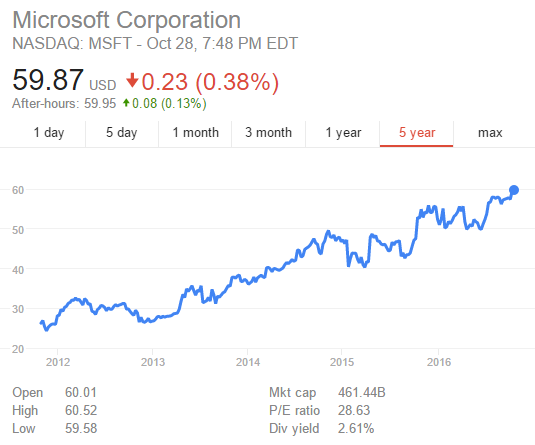
- Similar to Apple, Microsoft also strives for innovation, which is probably what attracted me most toward investing. Their CEO, Bill Gates, claims that innovation is what keeps our world moving forward. Recently, Microsoft has shaved their old image and created a more fresh one, which is something that draws my attention, because this shows how devoted they are to change. Microsoft is part of the technology industry, which is no longer a want, rather, it’s becoming a need in today’s society; since Microsoft is in charge of over 90% of the software run on computers today, I think it’s a good idea to invest in them. As you can see from the graph below, Microsoft is at an all-time high in the past five years. To me, it looks like it will continue to rise. The company has a P/E ratio of 28.63, and a dividend yield of 2.61%. This investment will be a mainly long term investment for me since I think the products and software Microsoft will be releasing will take a huge effect on their stock prices.
Portfolio I - One-year investment ($2960.09)
- 17 shares of Disney @ $93.85 ($1595.45) - 53.9%
- 12 Apple Shares @ $113.72 ($1364.64) - 46.1%
These two companies have an ROI of 17.79%. Hopefully, this ROI will stay the same, and I'll be able to turn a profit on my investments. This will result in a $503.22 payout.
Portfolio II - Five-year investment ($15,215.06)
- 39 shares of Disney @ $93.85 ($3660.15) - 24.1%
- 193 shares of Microsoft @ 59.87 ($11,554.91) - 75.9%
Combined, these two companies have an ROI of 82% (for a five-year investment). By this point, I should have made enough money to pay off any of my debts (student loans, taxes, payments, etc.). This will result in a $12,476.35 payout.
Portfolio III - Twenty-five-year investment ($30,948.50)
- 270 shares of Microsoft @ 59.87 ($16,164.90) - 52.2%
- 130 Apple Shares @ $113.72 ($14,783.60) - 47.8%
Together, these two companies have an ROI of 462.5% (for a twenty-five-year investment). At this point, I should have made enough money to reach my goal of owning a car and house. This will result in a $143,136.81 payout.
Total Investment Portfolio Value: $156,116.38
Below I've posted a pie chart of my total investment portfolio, to help better understand the amount invested for each payout:
Below I've posted a pie chart of my total investment portfolio, to help better understand the amount invested for each payout:
 |
| Portfolio Data. 2016. via MetaChart |
I'm happy with the companies that I chose. Overall, I think that my 3 business's stocks will continue to rise and keep a steady ROI. The economic moats of these companies were a big factor I thought of when choosing what stocks to invest in. Protection against a business is extremely important because nowadays it's a cut-throat society; companies can take over others within months. The values of the companies I chose were also a big determinant. I wanted businesses that were focused on innovation, and it was essential to me that they weren't planning on putting out the same product in the future. Something I learned while picking my stocks was a market cap. This is the total value of all the company's stocks. I payed attention to this because I wanted to make sure they were experienced and had a lot of other's investing in them as well.
Assumptions:
- I assume my twenty-five-year investment will make the most money, therefore I invested the majority of my savings into it.
- With the increase in Disney's stocks after the first Star Wars movie release, I assume that they will continue to rise again after the upcoming releases.
- The stock market won't crash during the 25 years I'm investing.
Sources:
- "Apple Inc." AAPL Stock Performance of Total and Trailing Returns. N.p., n.d. Web. 27 Oct. 2016.
- Downie, Ryan. "Buffett's Moat: Is Apple's Competitive Advantage Sustainable? (AAPL)." Investopedia. N.p., 20 June 2016. Web. 29 Oct. 2016.
- Harden, Seth. "Star Wars Total Franchise Revenue." Statistic Brain. N.p., 25 Jan. 2016. Web. 28 Oct. 2016.
- “Investment Risk Tolerance Quiz.” Rutgers. N.p.,n.d. Web. 28 Oct. 2016.
- "Walt Disney Co. (DIS) | Valuation Ratios." Stock Analysis on Net. N.p., n.d. Web. 25 Oct. 2016.
Friday, October 21, 2016
Optimism: Fueling Innovation.
For this Unit in Journalism, Sound, we learned about different types of music and how to create our own podcasts. In class, we were taught about Ira Glass and his ideas around storytelling, and how to formulate a good story. For our Field Experience, we went to Columbia College, where we learned about their Journalism department and how they operate everything on their end. For our Action Project, we were assigned to choose a specific figure from the 20th century whose voice had a lot of impact to the century. With this person, we needed to tell a story through our own podcast/interview. I chose Bill Gates, because I view him as one of the biggest innovator in the business and technology industries. Not only did he build one of the biggest companies from the ground up, but he became known as one of the biggest innovators in the world. With my story, I wanted to tell the story of innovation, and how he's built this entire empire. Thanks for reading and I hope you enjoy my project.
| WHEN | WHO/HOW | WHAT |
| 0:04 0:20 1:01 1:09 1:19 1:42 1:53 2:25 2:29 2:53 2:57 3:20 3:23 3:49 3:55 | Bill Gates Sam Bill Gates Sam Bill Gates Sam Cowell Edwina Cowell Sam Cowell Edwina Cowell Sam Cowell Edwina Cowell Sam Cowell Edwina Cowell Sam Cowell Edwina Cowell | Whether you’re a scientist with a new discovery, or working in the trenches to understand the needs of the most marginalized. You’re advancing amazing breakthroughs in what human beings can do for each other. Hi, this is Sam from GCE Lab School in Chicago. Today we’re going to be talking about Bill Gates and his impacts on the 20th century. Bill Gates is an American business magnate, investor, author and philanthropist. Gates’ story began after dropping out of Harvard University in 1975 to pursue his ambition of starting a company with his business partner, Paul Allen. Microsoft rose to become one of the biggest companies in our society today. Although Gates was not in the public eye as he was making impact, his voice and character alone is something that has shaped the way we live our lives today. Innovation can solve almost any problem. Before we begin with the interview, I’d like to take the chance to ask that you think about the ways Bill Gates has impacted your life while you’re listening Even in dire situations, innovation fuels innovation and leads to new approaches that eliminate suffering. But if you never see the people who are suffering, your optimism can’t help them; you will never change their world. Today we have EC with us. Because you’ve gotten the chance to see Bill Gates progress over the past 40 years, I want to ask you what impact you’ve seen him make throughout the 20th century? He was the father of a vast amount of the technology we use today. When I was young, we didn’t have computers at all, so we weren’t able to use the tools most children have for education today. Although I didn’t see Bill Gates himself as a famous figure changing the world, I was able to see his impact through the electronics evolving around me. Are there any specific ways that he’s made an impact on your life? Absolutely. Almost all the work that I do today, and most of the work that I did in my 30s and 40s were done on Windows computers. I used to do some desktop publishing almost 20 years ago, and I remember using Microsoft Publisher to create newsletters for the animal shelter I volunteered at, and I was able to do them right from my desk at home. In what other ways do you think he has impacted the world around us? Not only did he make these revolutionary innovations in technology, but he became a leader in business itself. Not only was he able to create the foundation for a company that’s turned into one of the biggest companies today, but he has become, i guess you could say, a universal icon for innovation and business. Have you seen Gates change society for the better? Well, what I think most impresses me about Gates is that as he became more wealthy and powerful, he really became more philanthropic, and started to use his wealth and celebrity to help people everywhere. He and his wife created a foundation that is trying to eradicate poverty and improve health all around the world. Alright, well thank you EC for sharing your thoughts with me today, and thank you to those listening. You’re very welcome. |
Friday, September 30, 2016
The Meaning of Life
For the first Unit of Journalism, we learned about the ideas of an image. In the beginning, we researched on an image that had a big impact on society. This helped us learn about how much meaning can be behind an image, and how pictures really can mean a thousand words. We watched a movie called Spotlight, which helped me visualize how effective Journalism in and of itself can be. For our Field Experience, we visited the Weinberg Newton Gallery, where we viewed an exhibit about the killings in Chicago. Each person who was killed over the summer of 2013 got their place of death photographed and displayed collectively on a giant wall. At the end of our unit, we compiled all the skills we learned and used them on our Action Project.
The Meaning of Life is a question that’s been pondered upon for years. Many people might say peace, money, or maybe friendships. Do we truly know why we’re all here?
Edwina Cowell, my mother and interviewee, defines the meaning of life as a connection through love. “Finding our own special gifts and talents and using them to connect with one another is my definition of the meaning of life.”
Mrs. Cowell lives in the suburbs of Chicago and works as a business owner and interior designer. She co-created a company named Spiritual Playdate with the help of her friends, which helps teach all different types of religion and spiritual curriculum for children. The idea for this sprouted after I was born when she had trouble figuring out how to educate me with her teachings. Mrs. Cowell says that through creating new forms of teaching, she’s making the most of the meaning of life: “I’ve been on a 30-year spiritual journey that has lead me to do what I do now.” Throughout this journey, she’s come to understand and make her own spiritual connections.
“When I was younger I probably didn’t think much about meaning, it was more about gratification, and as I’ve been growing older, I’ve paid a lot more attention to bigger philosophical questions such as “Why are we here?”, I’ve spent a lot of time studying different ideologies of faith, and those studies have lead me to believe that we’re here to learn to love.”
Because Mrs. Cowell runs a company where spirituality is so prominent, I decided to touch on the subject of God. When asked about the idea of God, she suddenly became more immersed in our conversation: “The concept of God may have come as an answer to the question of what happens after we die. My idea of God is more of a force; it is a light and love and energy that connects all matter, a vibration, if you will that’s powerful and runs through everything, but I feel it’s something that you can tap into.” During the creation of her business, Ms. Cowell has dealt with all different types of religious and spiritual beliefs. I thought it was interesting how she’s learned all these different teachings, which a lot of other people follow as their meaning of life. “There are many people that have faith in different things such as a monotheistic God which is a single creator, many Gods, or a force. People call all of these things God and find faith in their beliefs.”
Our interview took place in our backyard on the sunny day of September 28th, 2016. I thought it would be the best location for us so that we’re in a comfortable setting; one that’s a good temperature and not too noisy so neither of us would be distracted. We sat on our patio so that we could admire the trees and the sky. She mentioned how it made her feel relaxed, and that the energy around us helped keep her motivated to carry on with her best responses. Feeling the warmth nature was providing helped us appreciate the environment. I believe the atmosphere truly helped Ms. Cowell when illustrating the meaning of life.
During the interview, being in nature helped us both stay focused. After embracing our surroundings, I ended up changing one of my questions. I asked about whether theology and science can coexist: “We’ve barely begun to scratch the surface of our universe. We may never have an answer to where we came from. All we have are theories, but the discovery process of science is critical and always strives to provide answers for us.”
Out of all the pictures I took, I thought this one represented Mrs. Cowell best because of the naturalistic aura it gives off. Originally, the photo was darker in the background, but I used Photoshop to make some of the plants and trees more vibrant. It’s better to have the environment around her stand out as well as herself because it paints an idea of her character. Also, I blurred the trees farther back to make everything up closer stand out more. I decided to use the sharpen tool to make the bark on the trees more dynamic.
This photo was taken in our backyard. I think it captures an essence and represents Mrs. Cowell’s meaning of life very well. The settings on the camera used was a wide open aperture of f/1.4 and a shutter speed of 1/30. I took a few pictures with flash, but it made her face far too bright; I wanted Ms. Cowell to be represented well, but not the only think you should focus on when looking at the image.
The Meaning of Life is a question that’s been pondered upon for years. Many people might say peace, money, or maybe friendships. Do we truly know why we’re all here?
Edwina Cowell, my mother and interviewee, defines the meaning of life as a connection through love. “Finding our own special gifts and talents and using them to connect with one another is my definition of the meaning of life.”
Mrs. Cowell lives in the suburbs of Chicago and works as a business owner and interior designer. She co-created a company named Spiritual Playdate with the help of her friends, which helps teach all different types of religion and spiritual curriculum for children. The idea for this sprouted after I was born when she had trouble figuring out how to educate me with her teachings. Mrs. Cowell says that through creating new forms of teaching, she’s making the most of the meaning of life: “I’ve been on a 30-year spiritual journey that has lead me to do what I do now.” Throughout this journey, she’s come to understand and make her own spiritual connections.
“When I was younger I probably didn’t think much about meaning, it was more about gratification, and as I’ve been growing older, I’ve paid a lot more attention to bigger philosophical questions such as “Why are we here?”, I’ve spent a lot of time studying different ideologies of faith, and those studies have lead me to believe that we’re here to learn to love.”
Because Mrs. Cowell runs a company where spirituality is so prominent, I decided to touch on the subject of God. When asked about the idea of God, she suddenly became more immersed in our conversation: “The concept of God may have come as an answer to the question of what happens after we die. My idea of God is more of a force; it is a light and love and energy that connects all matter, a vibration, if you will that’s powerful and runs through everything, but I feel it’s something that you can tap into.” During the creation of her business, Ms. Cowell has dealt with all different types of religious and spiritual beliefs. I thought it was interesting how she’s learned all these different teachings, which a lot of other people follow as their meaning of life. “There are many people that have faith in different things such as a monotheistic God which is a single creator, many Gods, or a force. People call all of these things God and find faith in their beliefs.”
Our interview took place in our backyard on the sunny day of September 28th, 2016. I thought it would be the best location for us so that we’re in a comfortable setting; one that’s a good temperature and not too noisy so neither of us would be distracted. We sat on our patio so that we could admire the trees and the sky. She mentioned how it made her feel relaxed, and that the energy around us helped keep her motivated to carry on with her best responses. Feeling the warmth nature was providing helped us appreciate the environment. I believe the atmosphere truly helped Ms. Cowell when illustrating the meaning of life.
During the interview, being in nature helped us both stay focused. After embracing our surroundings, I ended up changing one of my questions. I asked about whether theology and science can coexist: “We’ve barely begun to scratch the surface of our universe. We may never have an answer to where we came from. All we have are theories, but the discovery process of science is critical and always strives to provide answers for us.”
 |
| SC, Cowell, 2016 |
This photo was taken in our backyard. I think it captures an essence and represents Mrs. Cowell’s meaning of life very well. The settings on the camera used was a wide open aperture of f/1.4 and a shutter speed of 1/30. I took a few pictures with flash, but it made her face far too bright; I wanted Ms. Cowell to be represented well, but not the only think you should focus on when looking at the image.
As for my opinion on the photo, I think it depicts Mrs. Cowell’s character and profile extremely well and relates to a lot of stuff touched on in the interview. It would fit really well if this were posted as an article. If I could change one thing, it would probably be the weather, but it was cloudy the day of the interview and there was really nothing I could do except brighten the sky. From this, I’ve realized that I enjoy editing pictures and making things stand out rather than taking pictures themselves.
Thursday, September 29, 2016
Plans for the Future
Overview of Unit 1:
For my first Unit in Econ at GCE, I have to say I really enjoyed the concepts we learned. Math has always been one of my stronger suits, so Supply and Demand came to me pretty quick. Learning from both a mathematical and conceptual view was something I’d never done before, and it was interesting understand the mechanics of the economy while also taking in the way people think about money. For our Field Experience, my class went to the Federal Reserve in Chicago, where we were lectured by an economist and learned about how money is dealt with; it was an enriching adventure. For my first Action Project, my class was assigned to formulate two different college paths we might take once we graduate high school. I chose the career of an Information Technology manager, because I’ve always had an insight for hardware and software programs. Not only did this help me pick my college major, but it aided me in mapping out my future financial plans, and how I’m going to pay off my student loans in the future, depending on the path I take. I’m glad we were assigned this for our introduction to the course, because it helped create a future guide that I otherwise would’ve been unprepared for.
Slideshow:
Audio:
For my first Unit in Econ at GCE, I have to say I really enjoyed the concepts we learned. Math has always been one of my stronger suits, so Supply and Demand came to me pretty quick. Learning from both a mathematical and conceptual view was something I’d never done before, and it was interesting understand the mechanics of the economy while also taking in the way people think about money. For our Field Experience, my class went to the Federal Reserve in Chicago, where we were lectured by an economist and learned about how money is dealt with; it was an enriching adventure. For my first Action Project, my class was assigned to formulate two different college paths we might take once we graduate high school. I chose the career of an Information Technology manager, because I’ve always had an insight for hardware and software programs. Not only did this help me pick my college major, but it aided me in mapping out my future financial plans, and how I’m going to pay off my student loans in the future, depending on the path I take. I’m glad we were assigned this for our introduction to the course, because it helped create a future guide that I otherwise would’ve been unprepared for.
Slideshow:
Audio:
Subscribe to:
Posts (Atom)